The
product
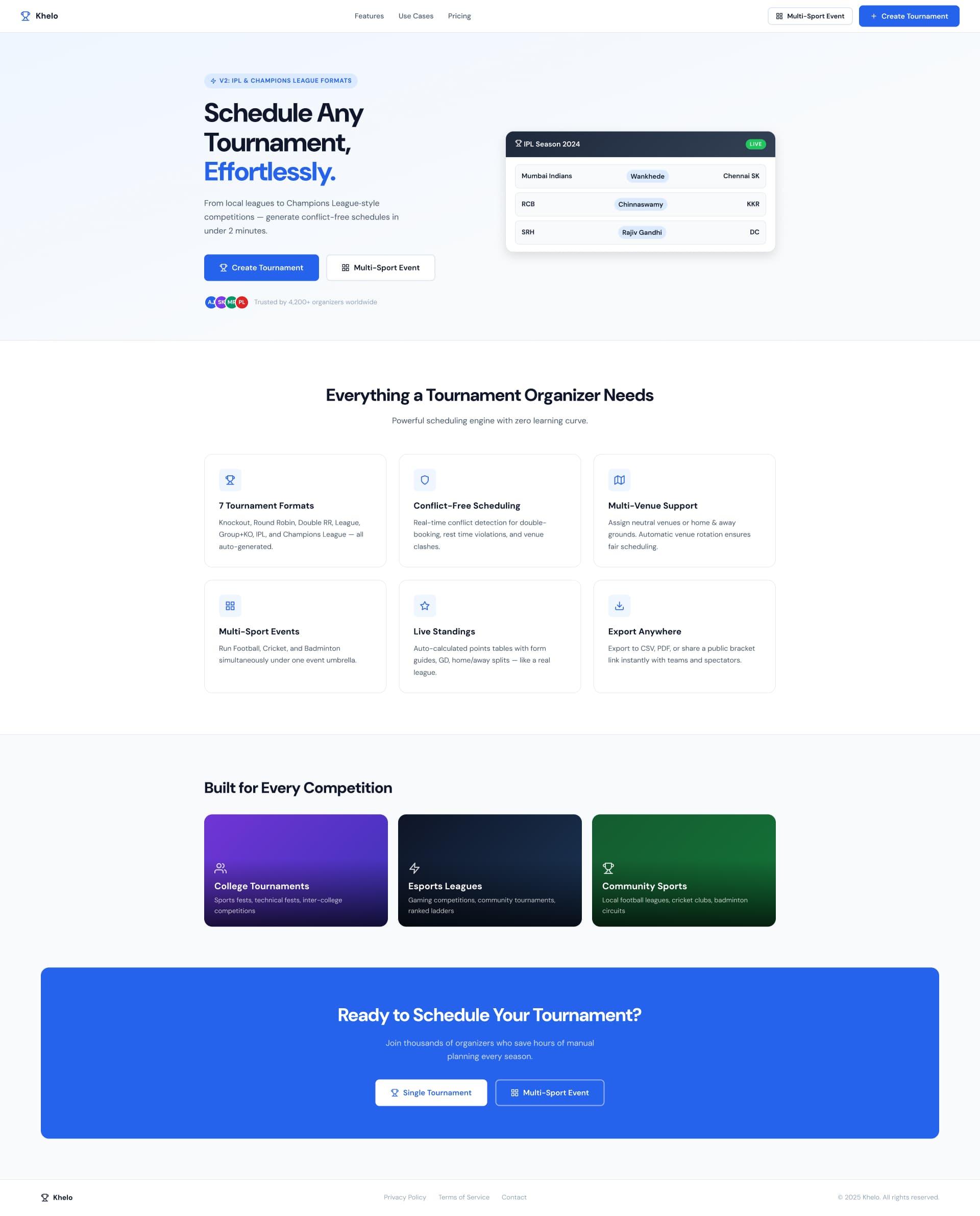
Khelo is a free, browser-based tournament management engine built for anyone who organizes sport - and a real product I'm preparing to launch. The name says it directly: khelo is Hindi for play. It's a deliberate signal that this product is built for India's sports culture - for the college sports fests, the community cricket leagues, the local football knockouts, the esports brackets that run on WhatsApp groups and broken spreadsheets. Khelo handles the full lifecycle of a tournament: setup, schedule generation, conflict detection and resolution, bracket visualization, standings, and calendar - across seven competition formats, for any sport, with no login and no install required.
What it fixes
Sports is personal for me. I've played in tournaments, watched them get organized badly, and seen what happens when scheduling is done manually - double-booked venues, teams playing back-to-back without rest, fixtures scribbled in notebooks that nobody can find on match day. The tools that exist for this are either too simple (a bracket generator with no scheduling logic) or too complex and expensive (enterprise sports management software built for professional leagues). There's almost nothing in between for the person running a college inter-department football tournament, a community cricket league, or an esports bracket among friends. In India specifically, this gap is sharp. Sports culture at the college and community level is enormous - but the infrastructure to support it is stuck in the 2000s.
Choices that shaped it
Wizard-first setup
Tournament creation is a multi-variable problem - format, team count, venue count, scheduling constraints, seeding method, group configuration, playoff structure. Presenting all of this at once would overwhelm any user. The setup flow breaks it into eight discrete, labeled steps with a visible progress bar. Steps are context-aware: group configuration and playoff steps appear only for formats that need them.
Format as a first-class choice
Most bracket tools force you into single elimination. Khelo supports seven formats: Single Elimination, Round Robin, Double Round Robin, League + Knockout, Group + Knockout, IPL Format, and Champions League - each with a fully implemented generation engine. IPL Format and Champions League are direct nods to competition structures Indian sports audiences know best.
Conflict detection surfaced explicitly
When the engine detects a scheduling conflict - a venue double-booked, a team assigned two simultaneous matches - a red conflict banner appears at the top of the schedule view listing each conflict with its exact match numbers and the specific problem. Khelo doesn't just flag conflicts - it auto-resolves them on demand, redistributing slots to eliminate clashes without requiring the organizer to do it manually.
Score entry as a modal workflow
Every match card in the schedule view opens an edit modal - team names, date, time, venue, status, and score. Updating a score and marking a match as complete is a five-second interaction. The conflict engine re-runs automatically on every save, keeping the schedule integrity check current throughout the tournament.
Clean, professional visual language
The design uses a light, high-contrast system - navy text, blue accents, white cards, subtle borders. A conscious choice against the 'sports tech' aesthetic of dark backgrounds and aggressive gradients. The tool needs to work in bright environments - sports halls, outdoor venues, college offices - where a dark UI is harder to read.
What's inside
- →7 tournament formats - Single Elimination, Round Robin, Double RR, League+KO, Group+KO, IPL, Champions League
- →8-step context-aware setup wizard
- →Automatic schedule generation - match pairings, time slots, venue assignments
- →Conflict detection - flags venue double-bookings and team scheduling clashes
- →Auto conflict resolution - redistributes time slots to eliminate flagged conflicts
- →Score entry modal - update scores, status, date, time, venue
- →Bracket view with round labels and match cards
- →Calendar view - week-by-week schedule with date controls
- →Live standings - overall, home, and away sub-tabs; W/D/L/GD/PTS tracking
- →Multi-sport event support - run multiple sports under a single event
- →CSV export, autosave to local storage
- ◇PDF and PNG bracket export
- ◇WhatsApp, Twitter, social sharing with public bracket links
- ◇Bracket auto-propagation - winners advancing rounds automatically
- ◇Community gallery - public browsing of shared tournament brackets
Where it goes next
Initial target: college sports coordinators and community league organizers in India - people who currently manage tournaments in WhatsApp groups and Excel sheets and feel the pain of that directly. The product doesn't need a massive user base to be valuable; it needs the right users - the ones who organize regularly, run real events, and have tried the alternatives. Khelo isn't just a product name - it's positioning. It communicates instantly that this product is for Indian sports culture, not a localized version of something built for someone else. That recognition matters at the community level where the initial launch is targeted. The base product is free. A Pro tier covering unlimited tournaments, PDF and PNG bracket exports, social sharing with public links, and community features is the natural paid layer.
What it taught me
Khelo came from a personal frustration. I love sport, I've organized tournaments, and I've done it badly because the right tool didn't exist. Building the tool I needed - naming it in a language that speaks to the audience it's for - and making it good enough to give to others is what this project represents. The prototype works. The problem is real. The next step is putting it in front of the people who feel that problem most acutely.